
Key Takeaways
- Glass fiber media has no heat-setting resin binder, so a pleated pack depends on adhesive to keep its shape.
- Without a glue line, pleats open under airflow, spacing drifts, and pressure drop climbs earlier than it should.
- Pleat height, pleat pitch and glue spacing are decided together, not one at a time.
- The machine sets the practical limit: fold accuracy, where the glue lands, and how fast the line runs.
- Media quality and filter design sit outside the machine, and no equipment choice can make up for them.
A flat roll of glass fiber media goes in at one end of the line. What comes out at the other end is a pack of evenly spaced folds, held apart by thin beads of hot-melt adhesive, ready to be cut and sealed into a frame. Holding that pack in shape, fold after fold, is what this article calls pleat stability.
Those two actions, folding and gluing, are usually described as separate steps. On glass fiber they are not. The media is stiff and brittle, and it keeps almost none of the crease, so the spacing has to be fixed while the fold is still under control. Add the adhesive later, in a second pass, and the pack has already begun to drift.
This matters because of what a pleated pack is asked to do. A single pack for HEPA air filters may carry several square meters of media inside a frame only a few centimeters deep, and every one of those square meters has to stay open and evenly spaced until the frame is sealed. When the spacing moves, air finds the easy path, dust follows it, and the filter reaches its final pressure drop long before it should.
Pleating and gluing are how that spacing is held. The rest of this article moves through the process in order: where the two operations sit on a production line, why glass fiber needs them, and which settings decide the result. It then looks at how those settings change with the filter type, and what a machine can and cannot do about it.
Where Pleating and Gluing Sit in Filter Production
A glass fiber line is shorter than a paper line, yet the sequence of filter production is much the same. Media leaves the roll, passes a slitter, runs through the pleater, and moves on to cutting and assembly. Each stage removes an option from the next one. Slit the roll to the wrong width and the pack will not fit its frame. Fold it at the wrong pitch and the cutter has nothing square to work from.
The pleater sits in the middle of that chain and carries two jobs at once: forming the fold and holding it. Everything downstream assumes both went well. Frames are sized to a nominal pack thickness. End caps are potted to a nominal pack height. A pack that has grown five millimeters during handling will still go in, but the edge seal is now doing work it was never designed for.
Two Operations That Have to Happen at Once
With paper media, pleating and gluing can be separated by minutes, sometimes by a whole shift. The resin in the media holds the crease while the pack waits. Glass fiber gives no such grace. Once the knife releases the fold, the media begins to relax, and the pleat opens by a small but growing amount.
That is why the glue head sits immediately after the folding station. The bead has to land while the pleat still holds the pitch it was given. A gap of a few hundred millimeters between the two stations is enough for the pack to lose its setting, and no pressure applied later will put it back.
Why the gap matters so much comes down to the material itself.
Why Glass Fiber Needs Glue to Keep Its Shape
Glass fiber earns its place in high-efficiency work because fine fibers trap particles that cellulose cannot capture. The same fineness is what makes the media difficult to fold: there is very little material in the sheet to carry a crease.
A Fold With Nothing to Hold It
Most cellulose filter paper is impregnated with a resin. Heat cures it, and the cured resin locks the crease in place. That is the main reason a paper pleat can survive stacking, cutting and shipping with no adhesive at all.
Glass fiber is a different construction. It is a mat of microfibers held together by fiber-to-fiber contact and a small amount of binder. There is no resin phase that softens and then sets. Fold the media and release it, and the fibers push back toward flat. The crease is a bend, not a memory.
A Very Small Margin Before the Fiber Breaks
Glass also has very little ductility. A fold has to be formed over a radius, not creased along a line. Press the knife too hard, or run the fold over too tight an edge, and fibers fracture at the crease instead of bending.
The damage is easy to miss at first. A hairline break at the fold looks acceptable on the machine. Later it shows up as loose fiber on the finished pack, as a weak line that opens during handling, or as a particle count that drifts during an efficiency test. None of that can be inspected back into the product.
What Happens When Nothing Holds the Pleats
Without a bead to separate them, pleats behave in a predictable set of ways.
- Pleats open under airflow. The pack balloons at the upstream face, and the pitch that looked correct on the bench no longer matches the drawing.
- Neighboring pleats touch. Where two folds meet, the media is blocked, so air takes the open channels and part of the media does no work.
- Spacing drifts along the pack. One end stays tight, the other opens, and the pack no longer fits the frame it was designed for.
- Edges leak. A pack that has moved cannot be sealed evenly, and unfiltered air finds the gap.
- Pressure drop climbs early. Blocked channels raise resistance, the fan curve shifts, and the filter reaches its change-out point with dust capacity left in hand.
Each symptom traces back to the same missing element: a fixed distance between one pleat and the next.
The Settings That Decide Pleat Geometry
That distance is not fixed by the media alone. It comes out of a handful of settings that decide pleat geometry: fold height, fold pitch, bead spacing, and the adhesive and line speed that lock them in place. None of them can be settled alone, and changing one forces the others to follow.
Pleat Height and Pitch
Two numbers set the geometry of a pack, and they pull against each other. Pleat height decides how deep each fold goes. Pleat pitch, the distance between one fold and the next, decides how many folds fit across the width.
More height and more folds both add media area, which is why a mini-pleat pack can carry so much media inside a shallow frame. The gain is not free. A taller pleat gives the air a longer path and gives the fold less support at its tip. A tighter pitch narrows each channel, and narrow channels raise resistance faster than the extra area can recover.
A practical starting point is to keep the opening between pleats wide enough for air to pass without accelerating sharply, then add pleats until the pressure budget runs out. Heavy dust loads push the design toward a wider pitch. Clean-air work with a tight budget pushes it the other way.
Glue Spacing and Line Pattern
The bead is not there to seal anything. It works as a separator, holding one pleat away from the next at a fixed interval, and in high-efficiency packs it took over from the aluminum separators that older designs relied on. Removing those separators freed space for media, and that is where much of the area gain in modern mini-pleat construction comes from.
Bead spacing is usually set around 25 mm, which balances support against obstruction. Closer beads hold the pack more firmly but cover more media. Wider beads leave more media open but let the pleats flex further under load.
The pattern matters as much as the spacing. Most pleating machines can lay a bead in one of three ways, and the choice changes how the pack behaves in service.
| Pattern | What it does | Effect on the pack | Where it suits |
| Continuous bead, full depth | Adhesive runs the full depth of the pleat | Highest rigidity, with a small loss of open media along the bead line | HEPA panels, V-bank filters, deep pleat packs and dust cartridges |
| Segmented bead | Adhesive laid in blocks with gaps between | Good rigidity with less adhesive coverage | Packs where adhesive coverage has to stay low |
| Intermittent bead | Short dashes at set intervals | Lowest restriction, and the least support against pleat movement | Light-duty HVAC work where pressure drop matters most |
Adhesive and Line Speed
The adhesive has to do two things at once: stay fluid long enough to reach the pleat, and set fast enough to hold it. EVA grades cover most HVAC work at moderate cost. APAO grades bond more readily to low-surface-energy media and stay flexible at low temperature. Polyamide grades take higher service temperatures and set harder.
Whichever grade is chosen, the open time has to match the line speed. At 5 m/min there is time for the bead to wet the media before the pack is compressed. At 12 m/min the same filter adhesive may still be soft when the pack leaves the gluing station, and the pleats will move as soon as tension is released. A grade that performed well on a slow line can fail on a fast one without anything else changing.
Matching the Settings to the Filter Being Built
No single set of values covers a whole product range. The same machine may run three different packs in a week, and each one asks for a different balance.
- HEPA panel and V-bank filters. Shallow frames, high pleat counts, tight pressure budgets. Height stays modest, pitch stays tight, and the bead has to be thin and consistent so it does not steal open area.
- Industrial dust cartridges. Deep pleats and heavy dust loads. The pack has to survive pulse cleaning, so the bead must hold each pleat against repeated reverse airflow rather than just keep it from moving.
- Cabin and engine air filters. Narrower widths, frequent changeovers, and a wide spread of media grades. Setup time matters as much as running speed here.
When the Mix Changes, the Settings Change
A practical way to plan the mix is to group jobs by bead pattern rather than by part number. Two packs that share a pattern and a common pleat height usually run back to back with a pitch change alone. A switch from a continuous bead to a segmented one may need a different head setting. Running the hardest job early in the shift also helps, because the first-off sample gets the attention it needs before the line is under pressure.
Changing between those product types is where a line earns or loses its keep. A job that needs a new glue head, a new knife set and half a day of setup gets avoided by operators, and the settings drift back toward whatever is easiest to run.
What the Machine Can and Cannot Control
This is where filter manufacturing equipment starts to matter. The material decides how much support a pleat needs. The filter design decides where that support has to sit. The machine decides whether either of those can be delivered at production speed, consistently, shift after shift.
Pleating and Gluing in One Pass
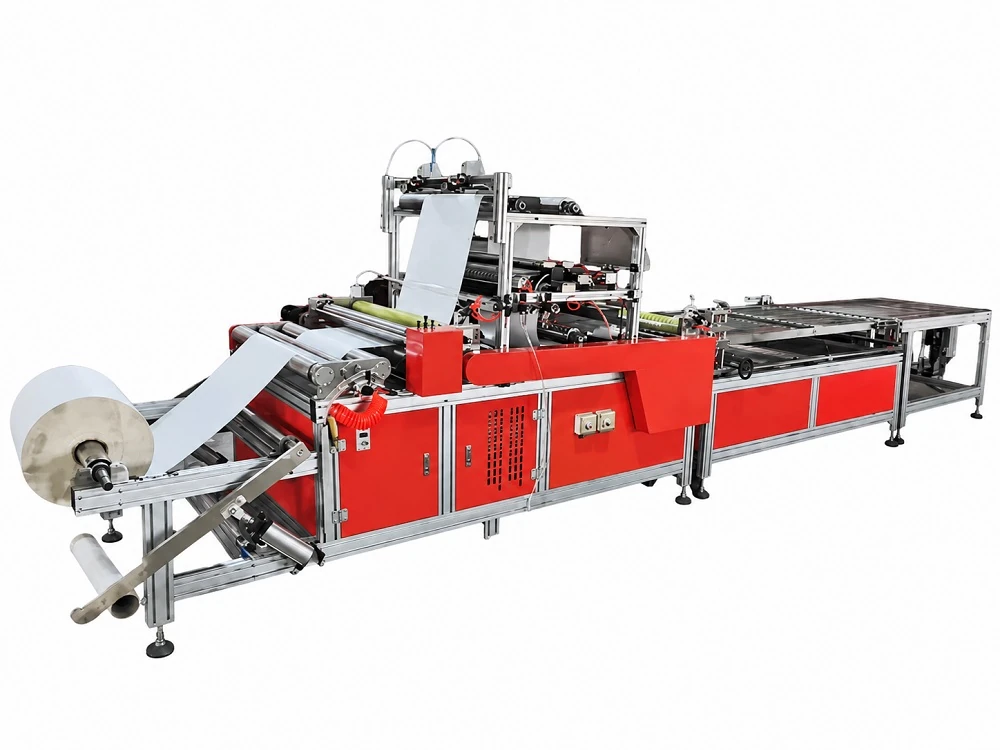
Combining the two operations on one machine frame closes the gap described earlier. The fold is formed, the bead is laid, and the pack is released only after the adhesive has taken hold. Nothing travels between stations, so nothing has a chance to open up on the way.
Settings the Operator Can Reach
Pleat pitch and pleat height are set from a PLC touchscreen rather than from mechanical change parts. Glue flow, bead interval and line speed are adjusted from the same screen, which shortens the changeover between two packs of different geometry.
The gluing head carries 26 nozzles on the upper side and 26 on the lower, each controlled independently. That arrangement allows a continuous bead, a segmented bead or an intermittent one without swapping hardware.
Capacity, Footprint and Power
Working width is 700 mm and the folding height range runs from 11 mm to 100 mm, so a single machine covers shallow panel packs and deep cartridge packs alike. Line speed runs from 5 to 12 m/min, which suits most air filter machines used by HVAC and automotive filter makers, and the low end is slow enough to keep a difficult glass fiber grade under control.
Total motor power is 4.5 kW. Working air pressure is 0.6 MPa, and the hot-melt tank holds 50 kg, which keeps refills infrequent on a long run. With a footprint of 8000 × 1150 × 1700 mm, floor space and service access have to be planned before delivery rather than after.
| Item | Value |
| Working width | 700 mm |
| Folding height | 11–100 mm |
| Line speed | 5–12 m/min |
| Total motor power | 4.5 kW |
| Glue tank capacity | 50 kg |
| Working air pressure | 0.6 MPa |
| Glue nozzles | 26 upper + 26 lower, independently controlled |
| Glue line spacing | 25 mm |
| Control | PLC touchscreen for pleat spacing, pleat height and glue settings |
| Voltage | 380 V (other voltages configured on request) |
| Media | Glass fiber filter paper |
| Footprint | 8000 × 1150 × 1700 mm |
What to Confirm Before the Machine Ships
Three things are worth settling in writing before a machine ships. First, a trial run on the buyer’s own media, because a fold that looks clean on a sample roll can behave differently on a production roll. Second, the electrical configuration: motors and heating elements are built to the destination grid, whether that is 380 V at 50 Hz, 220 V at 60 Hz or 415 V at 50 Hz. Third, documentation and support — electrical schematics, a one-year warranty, and a route for remote troubleshooting when a bead starts to string at two in the morning.
Where the Machine Stops
A machine can hold a fold and place a bead with repeatable accuracy. It cannot improve the media it is given, and a glass fiber roll with uneven binder distribution will fold unevenly no matter how the knife is set. It cannot choose the adhesive for the application either. Pleat height and pitch come from frame depth, the airflow target and the dust load. All three are settled before anyone chooses equipment.
Knowing where that line sits helps both sides. It stops a buyer from expecting a machine to solve a media problem, and it stops a supplier from promising that it will.
Frequently Asked Questions
Why do glass fiber pleats need glue while paper can often hold its shape without it?
Most paper is impregnated with resin, and heat sets the crease. Glass fiber has no resin phase to lock the fold, so the pleat pushes back toward flat once the knife releases it. Many paper packs still use a bead, but for spacing under airflow rather than to hold the fold.
How does pleat pitch affect filter performance?
A tighter pitch fits more media into the same frame, which lowers face velocity and can extend service life. It also narrows each channel, and narrow channels raise resistance. The right pitch depends on the airflow the filter will see and how much dust it has to hold.
What happens if the glue line is too thick or too thin?
A bead that is too thick covers working media along its path, adds resistance and can squeeze into the pleat root. A bead that is too thin collapses under load, so the pitch drifts and the pack loses the geometry it was designed around. Consistency matters more than either extreme.
Can one machine run both glass fiber and synthetic media?
On a machine built for both media, often yes, with setup changes. Glass fiber needs lower fold force, a wider fold radius and tighter tension control. Synthetic media usually tolerates more force but may need different glue temperatures. Sample trials on both materials are the only reliable way to confirm.
How do I know which pleat height my filter design needs?
Start with the frame depth, then work back from the airflow and the pressure drop budget. Once the geometry is fixed, check that the pack can still be glued and cut cleanly at that height. A prototype run settles the question faster than any calculation.
Conclusion
A pleated pack holds its shape because someone decided how it would be held, then set the line to deliver that decision the same way on every shift. Material, geometry, bead pattern and line speed all point in the same direction, and the machine is what keeps them pointed there. That is also the honest way to compare filter manufacturing equipment: not by headline speed, but by how much of this control it puts in the hands of the operator.
If you are planning a glass fiber pack and want to see how your own media behaves before committing to a configuration, send a roll with the frame drawing, and we will run the trial.