
Key Takeaways
- Filter support parts usually start as rolled mesh, and coiled metal keeps a natural curl that skews cuts if you skip leveling.
- A flattening and cutting machine unwinds the coil, bends it flat between staggered rollers, and shears it into preset-length sheets in one pass.
- Expanded metal mesh, woven wire mesh, and perforated sheets each behave differently, so equipment must be matched to the material.
- Leveled mesh sits flatter in frames and wraps truer around cores, which cuts downstream rework.
- This machine runs at 15 meters per minute, and the roller layout and cut-length control matter more than the headline speed.
What Is a Metal Mesh Flattening and Cutting Machine?
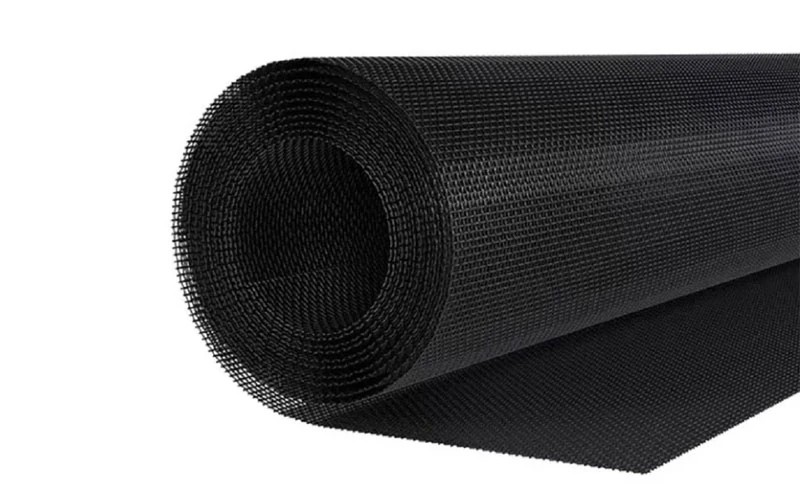
Inside every panel air filter or hydraulic element, the pleated media leans on a metal support structure: a flat frame behind the pleats, or a rigid inner core that holds the media open under flow. Those support pieces almost always start as a roll of metal wire mesh. Unrolling that coil and cutting it into usable sheets, however, is nothing like slicing cardboard. The strip wants to curl, the edges want to wander, and a blade pushed against a curved strip will wander right along with it.
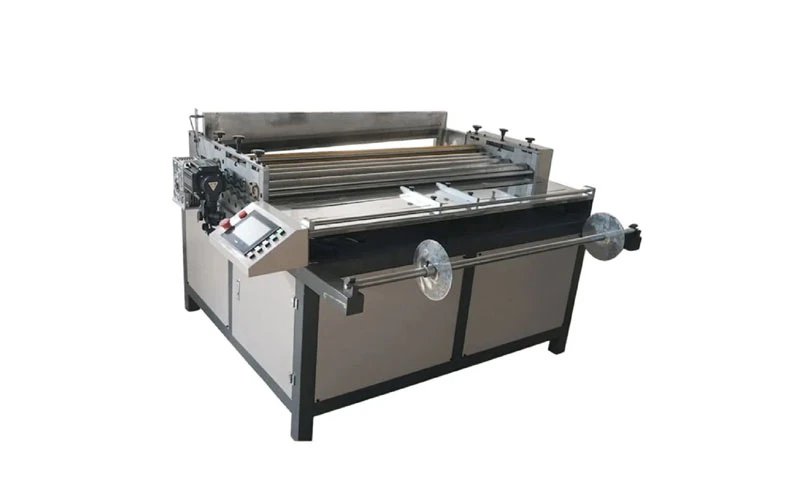
That is exactly the problem this category of equipment solves. A flattening and cutting machine unwinds mesh from a roll, pulls it across a set of leveling rollers, and shears the leveled web into flat sheets of a preset length — without a second setup. Think of it as the bridge between a raw coil and a part the next station can use: the rollers erase the coil’s natural set, and the cutter divides the leveled material into pieces that pleating, welding, or assembly stations receive ready to work with.
Why Flatten the Mesh Before Cutting?
Mesh reaches the shop in wire mesh rolls, and wrapping a thin, semi-rigid strip around a core bends the metal past its elastic limit. The material remembers that bend. Unroll it, and it springs back into a shallow arc; underneath the surface, internal stress is still waiting to release. Cut that arc on a shear, and the result is rarely a clean rectangle. The strip feeds in at an angle, so the first cut skews. A curved web can slide sideways under the blade, leaving ragged edges. And even after the cut, the sheet keeps curling, which makes it hard to seat in a frame or wrap around a core.
For filters, those small defects travel down the line. A support sheet that does not lie flat cannot press the media evenly against the end caps. A skewed frame opens gaps where unfiltered air slips past the media. A slightly springy core can even burst pleats during assembly, shortening the element’s life before it leaves the plant.
Flattening first and cutting second fixes the root cause. Relieve the stress while the material is still a continuous web, and only then divide it into parts. The goal is not a prettier-looking sheet; it is handing the next workstation a piece that stays put, comes out to the length you set, and has edges straight enough to weld, pot into adhesive, or slide into a housing without adjustment.
How Multi-Roller Leveling Works
A coil of mesh carries stress in more than one direction. It wants to curl around the roll axis, and it often holds a slight cross-bow as well. One heavy press cannot chase both curves evenly. Instead, leveling runs the strip through a row of offset rollers — several above, several below — so the mesh bends slightly one way, then the other, over and over. Each pass bends the material just enough to even out the stress, and the deflection grows gentler as the strip approaches the exit. By the last roller, the strip has been trained to stay flat on its own.
The same logic applies whether the mesh is woven, expanded or perforated, and it explains why roller count and spacing matter. More rollers spread the bending over smaller increments, which treats fine weaves gently and avoids over-stressing thin strands.
That detail matters most inside high-pressure elements. A hydraulic element needs a rigid inner skeleton that holds the pleated media against the flow. Stainless steel wire mesh is the usual choice here, because it shrugs off oil and temperature, and a leveled sheet wraps the core tube with even tension instead of springing open at the seam. The cleaner the leveling, the truer the cylinder — and the longer the element survives in service.
Key Parameters to Compare
When buyers line up machines in this category, four numbers carry the decision: the roller layout (how many rollers, and how upper and lower sets interleave), the working speed, the motor power, and the range of materials the machine is built to handle. Speed and power shape throughput, yet material compatibility decides whether the machine is worth a conversation at all.
The support material itself changes the job. A raised diamond pattern behaves nothing like a tight weave, and a perforated sheet behaves nothing like either. The table below summarizes the three common support materials.
| Mesh type | Typical form | Why it needs leveling | Typical filter use |
| Expanded metal mesh | Roll, raised diamond strands | Stretched strands sit at an angle and carry coil curvature; flattening produces a flat backing sheet | HVAC panel filter frames and air filter backing |
| Woven wire mesh, often stainless steel | Roll | Coil set and slight weave waviness cause skewed cuts and uneven wrapping | Hydraulic element support cores, air compressor intake screens |
| Perforated sheet | Sheet or narrow coil | Punched holes release uneven stress, leaving edges that lift or twist | Liquid and agricultural strainers, industrial filter baskets |
Worth remembering: expanded metal mesh leaves the expanding press with its strands raised at an angle. That raised shape is fine for architectural walkways, but a filter frame needs a flat plane — which is exactly why a leveling deck is part of the line.
Common Applications in Filter Production
Once the mesh is flattened and cut to size, it disappears into parts buyers never see. The most common uses are:
- Panel filter frames for HVAC: flattened expanded-mesh sheets cut to exact panel sizes sit behind the media in residential and commercial HVAC units, acting as a rigid backing for the pleats.
- Hydraulic filter support cores: leveled woven mesh is cut into the inner support layers of lube and hydraulic elements, holding the pleated media open under working pressure.
- Air compressor intake screens: cut-to-size mesh discs and rectangles screen the intake air before it reaches the compressor.
Automatic Metal Mesh Flattening & Cutting Machine
The machine that puts this entire workflow on a single footprint is the Automatic Metal Mesh Flattening & Cutting Machine from Fupei. It belongs to the broader family of filter-media converting equipment that prepares filter media and mesh for assembly, yet it is purpose-built for stiff metal mesh rather than soft paper or nonwoven rolls. One operator loads the coil, dials in the cut length, and the line flattens and shears the rest automatically.
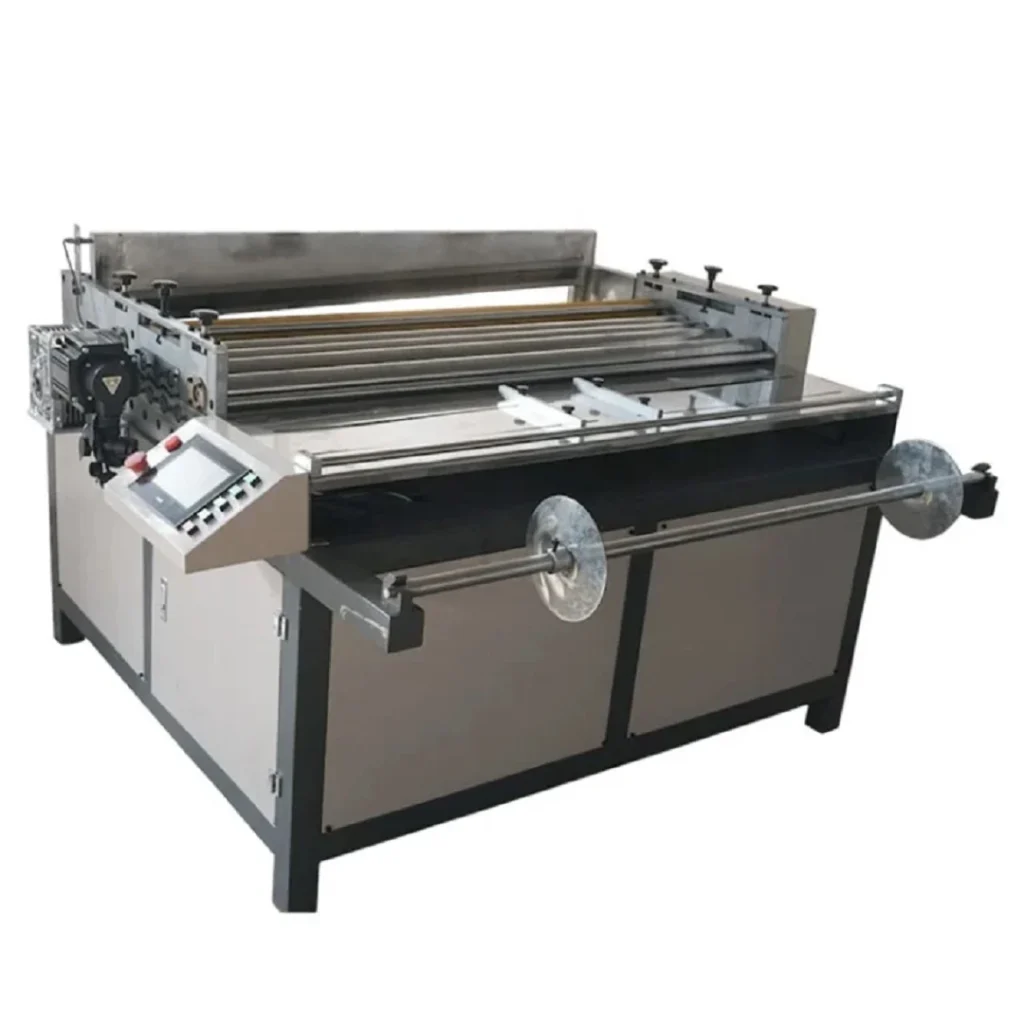
The 9-Roller Flattening System (4 Upper / 5 Lower)
Nine leveling rollers — four on top and five underneath — grip the strip in an alternating pattern. The interleaved layout bends the mesh progressively across its full width, smoothing coil curvature, creases, and tension wrinkles before the material reaches the blade. Hardened alloy rollers keep pressure even on thick or rigid meshes, with no vibration to disturb the cut.
Straight, Burr-Free Cutting to Set Length
After the strip leaves the roller deck, it feeds directly into a heavy shear. The blade cuts strictly to the length the operator presets, so every sheet leaves the line at the same dimension, with a clean, straight edge and no deformation. Because the mesh is already flat when the blade meets it, there is no strip wander, no skewed first cut, and no manual squaring-up afterward.
Built for Continuous Factory Shifts
| Parameter | Value |
| Machine type | Automatic flattening and cutting machine |
| Applicable material | Expanded metal mesh, woven wire mesh, perforated sheets |
| Flattening rollers | 9 rollers (4 upper / 5 lower) |
| Processing speed | 15 m/min |
| Motor power | 2.2 kW |
| Control | Manual / electronic control interface |
| Warranty | 1 year |
| Origin | China |
At 15 meters a minute on a 2.2 kW drive, the machine is sized for mid-volume filter shops rather than mega-scale stamping lines. A reinforced steel frame holds the cut steady even on rigid mesh, while the electronic control interface lets operators enter cut lengths without a tool-room setup.
Support for Global Filter Workshops
Before shipment, every machine runs trial cycles on real wire mesh, so roller alignment and cut accuracy are already proven when the unit reaches the plant. The motor and control electricals can be configured for the destination grid — 380V/50Hz, 220V/60Hz, or 415V/50Hz. Each order ships with a one-year warranty, full electrical diagrams, and remote video troubleshooting, so a line on another continent still gets a response when a roller or blade needs attention.
Frequently Asked Questions
Why does metal mesh need to be flattened before cutting?
Because coiled mesh carries a permanent curl. Cut the coil directly and the strip feeds at an angle, the blade skates across a curved surface, and the finished sheet keeps curling after the cut. Running the mesh through leveling rollers first removes that set, so the blade meets a flat, stable web and every cut comes out straight and repeatable.
What materials can a metal mesh flattening and cutting machine handle?
Machines in this class typically process expanded metal mesh, woven wire mesh, and perforated sheet metal used for filter support frames. Soft media such as cellulose filter paper, fiberglass, or nonwovens belong on a different converting line built around tension control; those lines slit and rewind, rather than shear stiff metal into flat sheets.
Does flattening weaken expanded metal mesh?
Flattening presses the raised strands into a flatter plane, so the mesh ends up slightly thinner and a touch less stiff in bending than its raised version. For filter support work, that trade is usually worth taking: a flat sheet mates cleanly against the media and the frame, and the small stiffness drop does not affect its job as a backing layer. Very thin or brittle alloys deserve a trial run first, to confirm they tolerate the roller pressure.
How is this machine different from a slitting machine for filter media?
In this filter-media context, they share the same equipment family, yet they do opposite jobs. A slitting machine takes a wide web of soft media — paper, nonwoven, fiberglass — and cuts it along the direction of travel into narrower strips, then rewinds them. A flattening and cutting machine feeds a stiff metal web across leveling rollers and shears it perpendicular to travel into flat sheets of a set length. One produces rolls of narrow media; the other produces flat support parts.
Conclusion
Flat support parts are one of those quiet details that decide how smoothly an assembly line runs. Cut coiled mesh without leveling it, and the rework follows — skewed frames, springy cores, operators wrestling sheets into place. Level it first, and downstream stations receive clean, predictable parts that fit on the first try.
If your shop already cuts mesh support shapes and wants the whole process on one automated machine, ask for a walk-through and a tailored quotation for the Automatic Metal Mesh Flattening & Cutting Machine. It takes in about 15 meters a minute of coiled mesh and hands you back flat, square sheets, ready for the next station.
Ready to cut flatter mesh sheets? Send Fupei your mesh types and required sheet sizes, and we will get back to you with a tailored quotation.