Key Takeaways
Choosing an oil filter winding machine starts with understanding what your filter elements need. The machine then needs to match their size, the winding material, production volume, and required level of consistency.
When comparing machines and suppliers, pay close attention to:
- Filter size, winding length, winding material, winding pitch, and tension control
- Automation and how consistently the machine can repeat the same winding pattern
- Compatibility with different filter models and winding materials
- Testing with your actual filter elements before shipment
- Customization, technical support, warranty, and after-sales service
A suitable machine should fit the products you already make without making future product changes unnecessarily difficult. The supplier should also be able to explain how the machine will work with your specific filters before you place an order.
Introduction
An oil filter removes contaminants from engine oil so the oil can continue to move through the engine while helping protect important components. Inside many oil filters is a filter element, the part that actually captures unwanted particles.
The filter material is often folded into many small pleats. This increases the available filtering area without making the filter much larger. However, these folds still need enough support to keep their shape during operation.
This is where an oil filter winding machine comes in. The machine wraps string or thread around the outside of the filter element to provide additional support. In simple terms, it works like adding a layer of external reinforcement around a flexible folded filter.
The process may look straightforward, but the result depends on several factors. Filter size, winding material, winding pitch, and tension all affect how evenly the string is applied and how well it supports the filter element.
For this reason, choosing an oil filter winding machine is more than checking a product name or comparing machine prices. You need to understand what your filter requires, which settings the machine can control, and whether the supplier can test and support the equipment properly.
What Is an Oil Filter String Winding Machine?
An oil filter string winding machine wraps string or thread around the outer part of a pleated filter element. The winding provides additional support around the folded filter material, helping it stay in shape during operation.
A typical machine rotates the filter while guiding the winding material from one end to the other. When these movements are properly matched, the string forms a regular spiral around the filter.
Think of it as a controlled wrapping process. The machine does not make the entire oil filter. Instead, it performs one specific production step that helps reinforce the filter element.
What Is It Used For?
The main purpose of string winding is to strengthen the outside of a pleated filter element.
Pleated filter media contains many folds to create more filtering area. These folds need to remain stable while oil or another fluid passes through the filter. Under high pressure or high flow, unsupported folds may bend, move closer together, or lose their original shape.
External winding adds support around the filter element. This can help the pleats remain in position and reduce the risk of collapse or deformation.
The same basic process can be used in several filtration applications, including automotive oil filters, hydraulic filter elements, and air-oil separators. Fupei’s machine is designed for these applications.
What Types of Oil Filter Elements Can It Handle?
The right machine depends heavily on the size and construction of the filter element.
Three measurements are especially important:
- Filter outer diameter — how wide the filter element is
- Winding length — how much of the filter needs to be wrapped
- Winding material — the type of string or thread used for reinforcement
The winding pattern matters too. Some filters need tighter spacing between wraps, while others can use a wider spacing.
For example, a machine designed for a small automotive filter may not be suitable for a much larger industrial filter. Manufacturers producing several filter models should therefore provide their complete size range before selecting equipment.
It is also important to ask whether different models can be handled by changing machine settings or whether additional mechanical adjustments are required.
Common Winding Materials
The winding material becomes part of the reinforcement around the filter, so it needs to suit the filter design and operating conditions.
Common materials include cotton yarn, polyester thread, and glass fiber string.
| Winding material | Key consideration |
| Cotton yarn | A flexible option for applications where conventional yarn reinforcement is suitable |
| High-strength polyester thread | Stronger and more resistant to stretching, making it suitable where stable winding is required |
| Glass fiber string | Suitable for applications that require stronger reinforcement and higher temperature resistance |
These materials do not behave exactly the same way during winding. Their flexibility and strength can affect how the material is fed and how tightly it can be wrapped.
For that reason, it is useful to confirm material compatibility before ordering the machine and, when possible, test the actual winding material you plan to use.
What Should You Look for in an Oil Filter Winding Machine?
Filter Size and Machine Compatibility
Start with your filter specifications, not the machine catalog.
The first question is simple:
Can the machine handle all the filter models you plan to produce?
At minimum, the supplier should know the filter diameter and the length that needs to be wound. If you produce several models, provide the full range rather than checking only your most common product.
Filter drawings or physical samples can also help. They give the supplier a clearer picture of the filter and make it easier to determine whether the machine can handle the winding area correctly.
A suitable machine should cover your current products while leaving enough flexibility for future models.
Winding Tension and Pitch Control
Two important settings are winding tension and pitch.
Winding tension means how tightly the string is pulled while it is being wrapped around the filter. If the tension is too low, the string may not provide enough support. If it is too high, it may put unnecessary stress on the filter media or cause the material to break.
Pitch is the distance between one wrap and the next. A smaller pitch means the wraps are closer together, while a larger pitch leaves more space between them.
Different filter designs may need different spacing. That is why a machine with only one fixed winding pattern can become restrictive when a manufacturer produces several products.
Look for a machine that allows operators to adjust:
- Winding tension
- Spiral pitch
- Winding speed
- Cycle settings
The control method matters as well. A clear interface makes it easier for operators to repeat the same settings when production changes from one filter model to another.
Material Compatibility
The machine should work with the winding material you actually plan to use.
Cotton yarn, polyester thread, and glass fiber string differ in strength, flexibility, and handling. These differences can affect how smoothly the material is fed and how consistently it is wound.
Before buying, confirm:
- Which winding materials the machine can handle
- Whether tension can be adjusted for different materials
- Which material is suitable for your filter design
The right material also depends on the filter itself. Winding machine suppliers should therefore discuss the intended material with you before finalizing the machine configuration.
Automation and Production Consistency
Automation becomes more valuable as production volume increases.
Imagine making hundreds or thousands of filter elements. Even a small difference in winding position or tension can become a repeated production variation if the process is performed manually.
An automatic machine helps reduce this variation by controlling the movement of the filter and the winding material during each cycle. The goal is simple: each filter should receive a similar winding pattern.
For manufacturers producing several filter models, saved recipes can also make product changes easier. Operators can store settings for different products and recall them when switching production.
Machine Testing and Quality Control
A machine should be tested under conditions that are as close as possible to real production.
Before placing an order, ask whether the supplier can test the machine using your actual filter elements and the key production conditions required for your application.
Fupei conducts pre-shipment trial runs with actual filter elements and checks mechanical alignment and winding tension stability before shipment. Video reports and calibration information can also be provided for review.
Testing with the actual filter gives both sides a chance to identify adjustments before shipment. Videos, test records, calibration information, or sample products can also help buyers review the result without visiting the supplier in person
Customization and Technical Support
Standard equipment does not always fit every production environment.
Winding machine manufacturer may produce different filter sizes, use a different electrical standard, or have limited space on the production floor. In these cases, a standard machine may need to be adjusted.
Before ordering, clarify:
- Which specifications can be customized
- Which changes are standard options
- Whether the machine can be adapted to local voltage requirements
- What technical documents are supplied
- How installation and troubleshooting support are handled
Fupei provides application-driven specification reviews, custom machinery engineering, installation and commissioning guidance, and remote technical support. The company also supports custom electrical configurations for local power requirements.
For overseas buyers, remote technical support can be especially useful because engineers may not be available on site during installation or commissioning.
Why Choose Fupei for Oil Filter Winding Equipment?
Product Overview
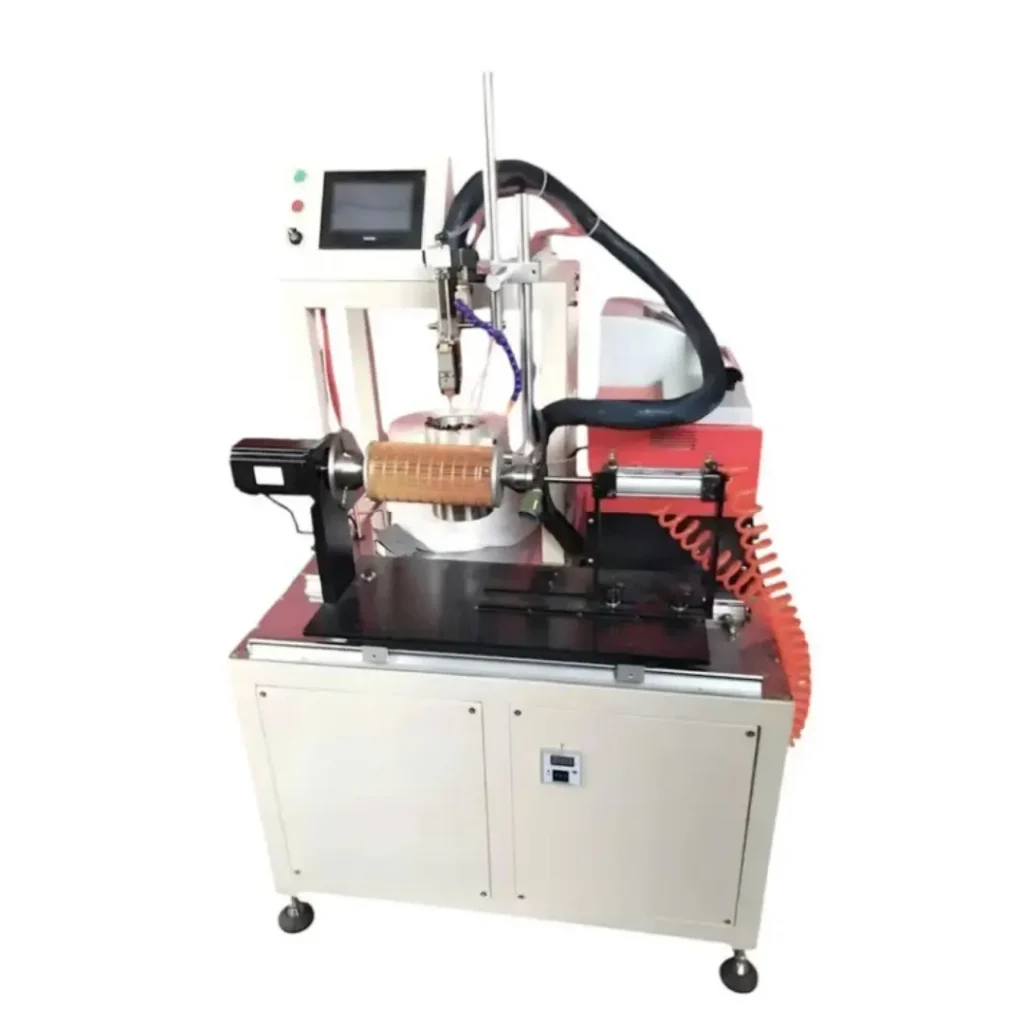
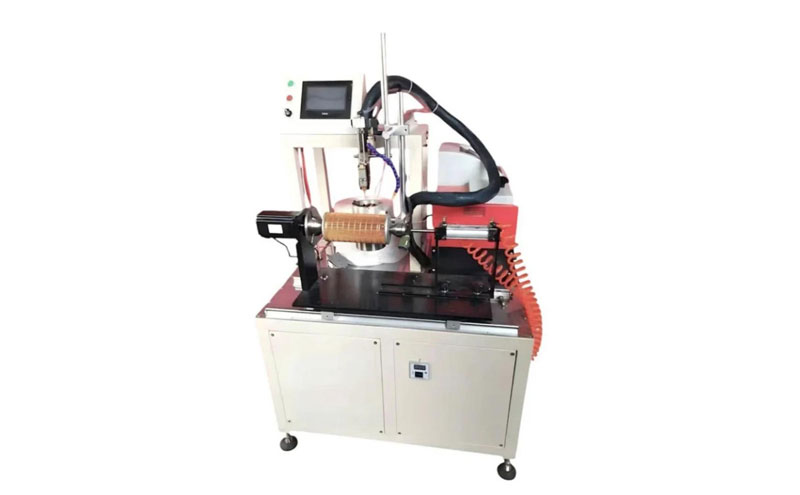
Fupei’s automatic oil filter string winding machine is designed to reinforce filter elements by automatically wrapping string around their outer pleats.
The machine uses automatic spiral winding with adjustable pitch and tension control. It is designed for applications including automotive oil and fuel filter elements, industrial hydraulic filter elements, and air-oil separator elements.
For manufacturers looking for winding equipment specifically for filtration applications, the machine can be evaluated directly against filter size, winding material, and production requirements.
Key Specifications
| Specification | Fupei automatic oil filter string winding machine |
| Maximum winding length | 1,000 mm |
| Optional winding length | Up to 1,200 mm |
| Maximum filter outer diameter | 300 mm |
| Optional outer diameter | Up to 400 mm |
| Winding materials | Cotton yarn, high-strength polyester thread, glass fiber string |
| Winding method | Automatic spiral winding with adjustable pitch |
| Motor power | 1.5 kW |
| Working air pressure | 0.5–0.6 MPa |
| Control | PLC touchscreen HMI |
| Standard voltage | 380V / 50Hz |
| Custom voltage | Available |
| Warranty | 1 year |
The maximum winding length tells you how much of the filter can be wrapped in one setup, while the outer diameter indicates the largest filter size the machine can handle within the stated configuration. These figures should be compared with the actual dimensions of your products before ordering.
Adjustable Winding Tension and Pitch
The machine uses an adjustable tension controller to help maintain stable tension while the string is being wound.
Operators can also adjust the winding speed and spiral pitch through the touchscreen HMI. In practical terms, this means the winding pattern can be changed when different filter designs require different spacing or wrapping conditions.
PLC Control and Recipe Management
The machine uses a PLC-based touchscreen control system. Rather than requiring operators to adjust every part mechanically, the main winding settings can be managed through the interface.
Operators can adjust winding speed, spiral pitch, and cycle settings. The system also supports multiple recipe storage, which can make it easier to switch between different filter models during production.
Multiple Winding Material Options
The machine supports cotton yarn, high-strength polyester thread, and glass fiber string.
This gives manufacturers more flexibility when different filter designs require different reinforcement materials. The material should still be selected according to the filter design and operating conditions rather than simply choosing the strongest option.
Filter Size and Configuration Flexibility
The standard configuration supports filter elements with a maximum outer diameter of 300 mm and a maximum winding length of 1,000 mm. Optional configurations can extend these limits to 400 mm in outer diameter and 1,200 mm in winding length.
For buyers producing several filter models, these figures should be checked against the dimensions of every product. This makes it easier to determine whether one machine can cover the full product range or whether a different configuration is needed.
Pre-Shipment Testing and Quality Control
Fupei states that each oil filter string winding machine undergoes trial runs with actual filter elements before shipment. The company also states that its engineering team checks mechanical alignment and winding tension stability during testing.
For an overseas buyer, this is useful because potential issues can be identified before the machine reaches the final production site.
The company also states that video reports and calibration information can be provided before shipment, giving buyers additional information to review the machine’s performance.
Customization and Electrical Adaptation
Fupei provides application-based equipment customization and non-standard machinery engineering. Its service offering includes drawing-to-sample workflows and adjustments for non-standard production requirements.
For international projects, electrical configurations can also be adapted to local grid requirements. The product page lists 380V/50Hz as the standard configuration and states that local voltage configurations can be customized.
This can be useful when the machine needs to fit an existing factory rather than operate in a standard setup.
Filtration Industry Experience
Fupei focuses on filtration machinery, filter materials, and related products. Its product range covers several stages of filter production, including pleating, gluing and dispensing, spiral tube production, slitting and rewinding, oil filter equipment, and auxiliary equipment.
With 20 years of industry expertise, Fupei provides application-driven specification matching to help buyers select equipment according to their filter drawings and production requirements. The company also works with a network of vetted manufacturing partners and provides quality inspection at the source.
This filtration industry experience can be valuable when a winding machine needs to fit into an existing production process or when buyers are sourcing multiple types of filtration equipment.
Export and After-Sales Support
For overseas buyers, support after delivery is an important part of equipment sourcing.
Fupei provides pre-shipment inspection, export documentation, logistics coordination, installation and commissioning guidance, remote technical support, and warranty service.
The automatic oil filter string winding machine comes with a one-year warranty and electrical schematics. Fupei also provides long-term remote video troubleshooting to support installation, operation, and problem solving after delivery.
This type of support can be particularly useful for overseas installations, where timely remote assistance can help resolve setup and troubleshooting issues without requiring an immediate on-site visit.
FAQ
What is a winding machine used for in oil filter production?
An oil filter winding machine performs one specific step in filter production. It wraps string or thread around the outside of a pleated filter element to provide additional support. It does not manufacture the complete oil filter by itself.
What materials can an oil filter winding machine handle?
The Fupei automatic oil filter string winding machine supports cotton yarn, high-strength polyester thread, and glass fiber string. The best choice depends on the filter design and the conditions in which the filter will operate.
How important is winding tension control?
Tension controls how tightly the string is pulled during winding. It is important because the string needs to provide support without putting excessive stress on the filter media. Adjustable tension makes it easier to adapt the process to different materials and filter designs.
Can the machine handle different oil filter sizes?
Yes, as long as the filter dimensions fall within the machine’s configured working range. The standard configuration supports a maximum outer diameter of 300 mm and a maximum winding length of 1,000 mm. Optional configurations can extend these limits to 400 mm and 1,200 mm.
What should I ask a winding machine supplier before buying?
Ask about the filter size range, winding materials, tension and pitch control, production speed, automation, testing procedures, customization, electrical requirements, warranty, technical documentation, installation support, and after-sales service. It is also useful to ask whether the supplier can test the machine with your actual filter elements before shipment.
Conclusion
Choosing an oil filter winding machine should start with the filter you actually produce. The machine needs to match your filter size, winding material, production volume, and required winding pattern. Just as importantly, it should give operators enough control to maintain consistent results as production continues.
Once the machine configuration is clear, the supplier’s testing, customization, technical support, and after-sales service become equally important. Fupei provides filtration-focused equipment, pre-shipment testing, customized configurations, export support, and remote technical assistance for international buyers.
Contact Fupei to discuss your filter specifications and find the right winding machine configuration for your production needs.